![we buy houses for cash [market_state]](https://image-cdn.carrot.com/eyJidWNrZXQiOiJwcm9kdWN0aW9uLmNhcnJvdC11cGxvYWRzLm9uY2Fycm90LmNvbSIsImtleSI6InVwbG9hZHMvc2l0ZXMvNzcxMjUvMjAyMy8xMi9XZS1CdXktSG91c2VzLUNhc2gtSG9tZS1CdXllcnMtQXJpem9uYS5qcGVnIiwiZWRpdHMiOnsicmVzaXplIjp7IndpZHRoIjoxMTUyfSwidG9Gb3JtYXQiOiJ3ZWJwIiwid2VicCI6eyJxdWFsaXR5Ijo3MH19fQ==)

Yes. Under Arizona law, a properly appointed personal representative can sell estate real property to an heir, and in unsupervised probate that usually can happen without a separate court order for the sale. The catch is that the representative must already have Letters of Personal Representative, the deal has to be fair to everyone else involved, and the price has to hold up if anyone questions it later.
That matters because many Arizona families aren’t asking a legal theory question. They’re asking a painful, practical one. A daughter wants to keep the home she grew up in. A son has been living in Dad’s house and can afford to refinance it, but his sister wants her share in cash. Someone lives out of state. Someone else doesn’t trust the numbers. Grief is sitting in the room with every conversation.
The good news is that Arizona probate law often allows a house sale during the estate administration process instead of forcing the family to wait until everything is fully closed. The harder part is handling the sale cleanly, especially when the buyer is also an heir, or even the personal representative.
Table of Contents
- A Common Arizona Inheritance Question
- How Arizona Probate Authority Actually Works
- Three Legal Conditions Every Heir Buyout Must Meet
- Three Paths Heirs Use to Buy Estate Property in Arizona
- A Realistic Arizona Example
- Hard Questions Most Articles Skip
- Practical Steps to Buy the House From the Estate
- Frequently Asked Questions for Arizona Heirs
A Common Arizona Inheritance Question
Maria lives in Phoenix. Her father has just passed away, and the family home is still in his name. Her first thought isn’t legal strategy. It’s simple and emotional. Can she buy the house from the estate before it gets listed to strangers?
In many Arizona cases, the answer is yes. Arizona gives a personal representative broad power over estate property once properly appointed. Under A.R.S. 14-3715, that representative may sell, mortgage, or lease estate property. In plain English, that means the estate can often sell the house to an heir while probate is still open, as long as the sale is handled correctly.
Why this feels confusing
Families often assume one of two things, and both can be wrong.
- “The will already says who gets the house.” A will may say who inherits, but that doesn’t by itself let someone transfer title.
- “Nothing can happen until probate is over.” In Arizona, estate administration often continues while the representative is already handling property decisions.
That’s why the question usually isn’t just whether an heir can buy the home. It’s whether the estate has the authority to sell it now, and whether the buyout is fair enough that no sibling, creditor, or later title reviewer will challenge it.
A family agreement may feel settled around the kitchen table, but title companies and probate courts care about paperwork, authority, and fairness.
The emotional part families don’t talk about enough
For many heirs, keeping the house isn’t only about money. It may be the place where holidays happened, where one sibling has been living, or where another sibling promised a parent the home would stay in the family.
That emotional pull can make people move too fast. They skip the appraisal. They assume everyone will stay agreeable. They rely on verbal promises. That’s where later conflict starts.
When sibling buyouts are part of the discussion, Red Rock Properties has a related guide on buying out a sibling from an inherited house in Arizona that helps families sort through the people side of the deal, not just the paperwork.
How Arizona Probate Authority Actually Works
Families often get stuck on one painful question: if everyone agrees that one heir should keep the house, why can’t that person just buy it right away?
Because agreement and authority are not the same thing.
In Arizona probate, the key player is the personal representative. This is the person named in the will, or appointed by the court, to handle the estate’s business. That role includes protecting the house, dealing with bills and creditors, signing sale papers, and making sure the transfer can stand up later if a sibling, title company, or court asks questions.
The document that proves that authority is called Letters of Personal Representative. A will can say who should inherit. The Letters are what let someone act for the estate. Without them, a family may have a plan, but no one has legal power to sign a valid transfer of title.
Authority works like a license to act
A will is closer to a set of instructions. The Letters are closer to the legal ID that lets the representative carry out those instructions.
That distinction matters more in a family buyout than people expect. If you are both an heir and the proposed buyer, the transaction gets extra attention later if anyone feels the price was too low or the process favored one sibling over another. Clear authority is the first layer of protection.
Unsupervised and supervised probate do not give the same freedom
Arizona probate cases are often either unsupervised or supervised, and that difference changes how a house sale happens.
In an unsupervised probate, the personal representative often has broad authority to handle estate property, including a sale, without asking the judge to approve each step. In a supervised probate, the court usually stays more involved, and a sale of real estate may need court confirmation before it becomes final.
That is why two families can both be “in probate” and still have very different timelines.
If you want a closer explanation of what a representative can and cannot sign, Red Rock Properties has a separate guide on whether a personal representative can sell property in Arizona.
Appointment is the start of authority, not the end of the job
Even after the personal representative is appointed, the house cannot be treated like private property that one heir can casually buy from another.
The representative still has duties to the whole estate. That usually means identifying estate assets, dealing with creditor issues, keeping records, and making decisions that are fair to all interested parties. In plain English, getting the Letters opens the door. It does not remove the responsibility to act carefully once you walk through it.
This is also where many family buyouts go sideways. One sibling says, “I’ll pay what Mom wanted,” while another says, “The market says it’s worth more.” The representative cannot solve that by guessing or by picking a number that keeps the peace for one afternoon. The sale price needs support in the file. The process needs to make sense on paper.
Why this matters so much in a family buyout
An heir purchase is not just a sale. It is a sale inside a relationship.
That means the personal representative is balancing two jobs at once. First, they are handling legal authority. Second, they are protecting the estate from later claims that the house was sold too cheaply, too quickly, or without fair notice to the other heirs. That is the harder real-world issue many Arizona probate articles skip.
In some families, full probate is not even the only path. Arizona’s small-estate affidavit rules can create a faster and less expensive route in the right situation, which can change how a family buyout is structured. But if probate is open, the starting point stays the same. The person with Letters holds the power to act for the estate, and that power has to be used in a way that other heirs can defend later.
Three Legal Conditions Every Heir Buyout Must Meet
A family buyout becomes much safer when it passes three tests. If even one is weak, the transaction can create conflict later.
The three-part test
| Three Legal Conditions for an Arizona Heir Buyout | What It Means | How to Document It |
|---|---|---|
| Authority exists | The estate must have a properly appointed personal representative with power to act | Certified Letters of Personal Representative, probate filings, and sale documents signed in the representative’s fiduciary capacity |
| Fiduciary duty is respected | The representative must treat all heirs and creditors fairly, not favor the buyer-heir | Written disclosures, written notice to interested parties, written consents or objections, and a clear file showing how the decision was made |
| Price is defensible | The buyout amount has to be supportable if a sibling, creditor, or court reviews it | Independent appraisal, broker price opinion, or strong comparable sales analysis kept with the estate records |
First condition, real authority
The first question isn’t whether the heir has financing. It’s whether the estate has authority to sell.
No Letters, no sale. A family handshake can’t replace legal authority. If the estate is supervised, court confirmation may still be required even after the representative is appointed.
Second condition, fair treatment of everyone else
The personal representative owes duties to the estate, not to one favored family member. That becomes especially sensitive when the buyer is also a beneficiary, or worse, the same person serving as personal representative.
Practical rule: The closer the buyer is to the person controlling the sale, the more important written disclosure becomes.
This is also where creditor issues matter. If the estate has debts, sale proceeds may need to satisfy those obligations before heirs receive their shares. When a property has tax problems, families often need a plain-English explanation of what is a tax lien on a house before they can judge whether the planned buyout is even workable.
Third condition, a price that can survive scrutiny
A fair price isn’t whatever the family prefers. It’s whatever the representative can defend with evidence.
That usually means getting outside valuation support. Not because every sibling is hostile, but because memories, guilt, and urgency distort judgment. If one heir later claims the house was sold too cheaply, the representative will need more than “everyone seemed fine with it.”
Readers sorting through valuation questions often find it helpful to review whether an appraisal is needed for inherited property in Arizona.
Three Paths Heirs Use to Buy Estate Property in Arizona
Arizona heirs usually reach a family buyout through one of three paths. The right path depends less on emotion and more on title status, creditor exposure, and how much formality the estate needs.
Side-by-side comparison
| Comparing Three Heir Buyout Paths in Arizona | Court Involvement | Typical Timeline | Best For | Main Limitation |
|---|---|---|---|---|
| Buy during full probate | The representative acts through probate. Supervised cases usually need court confirmation | Maricopa County probate guides commonly describe an uncontested probate timeline of roughly 6 to 12 months according to Arizona probate timing guidance | Estates with active administration, title issues, mortgages, or creditor concerns | More paperwork and longer administration |
| Use the small-estate affidavit route | Avoids full probate if the property qualifies | At least 6 months after death must pass, and Arizona guidance discusses the newer real-property affidavit path for net equity under $300,000 in qualifying cases in Maricopa County small-estate guidance | Lower-equity properties where a full probate may be avoidable | Not every property qualifies, and title-clearing still matters |
| Buy with co-heir consent during administration | Usually limited court involvement in informal, cooperative cases | Depends on how quickly heirs agree and the estate can document the file | Families that agree on value and want a clean internal buyout | One holdout heir can slow or derail the plan |
Path one, buying during full probate
This is the most familiar route. The personal representative gets appointed, receives Letters, and signs the sale documents on behalf of the estate. This path often fits homes with unresolved debts, mortgages, or multiple moving parts.
It may feel slower, but it often gives the cleanest paper trail.
Path two, using the small-estate shortcut
Arizona also recognizes a simplified transfer path for certain smaller estates. A real-estate affidavit procedure may be used instead of full probate if the property qualifies and enough time has passed. This route creates a meaningful shortcut in some family buyouts, especially where the home has modest net equity.
That can surprise heirs who assumed probate was the only option.
Path three, co-heir agreement
Sometimes the cleanest solution is old-fashioned cooperation, but documented properly. One heir wants the house. The others want their share in cash. Everyone signs written consents, the representative conveys the property, and the estate accounts for the money.
When agreement breaks down after title has already moved into multiple heirs’ names, disputes can become co-owner disputes rather than probate disputes. In those cases, families may need to understand partition action for inherited property in Arizona.
A Realistic Arizona Example
A father in Phoenix dies with a will leaving his home equally to his two adult children. One child has been living in the house and wants to keep it. The other lives in Tucson and would rather receive cash than deal with a future sale.
The child who wants to stay in the home is also named personal representative. That doesn’t automatically stop the deal, but it raises the standard for documentation.
How the example plays out
First, the personal representative opens probate and gets Letters of Personal Representative. The estate is handled as an unsupervised administration, so there isn’t a separate sale hearing built into every step.
Next, the representative orders an independent appraisal. The appraised value becomes the anchor for the proposed buyout. That appraisal is shared with the sibling who isn’t buying the house, along with the proposed settlement statement and explanation of how net proceeds will be divided.
The best family buyouts are not secret. They’re documented so clearly that an outsider could understand them without hearing anyone’s side of the story.
The buying heir then applies for financing in an individual capacity, not as the estate. Escrow opens. Title reviews the probate file, the Letters, and the vesting path from the estate to the buyer.
Why this example matters
Nothing dramatic happens here. That’s the point.
A sound Arizona heir buyout often looks boring on paper. There’s authority. There’s valuation support. There’s written consent or, at minimum, full disclosure and a clear chance to object. The estate pays what it must pay, and the remaining value is distributed according to the will or applicable inheritance rights.
The stress usually comes from relationships, not from the deed itself.
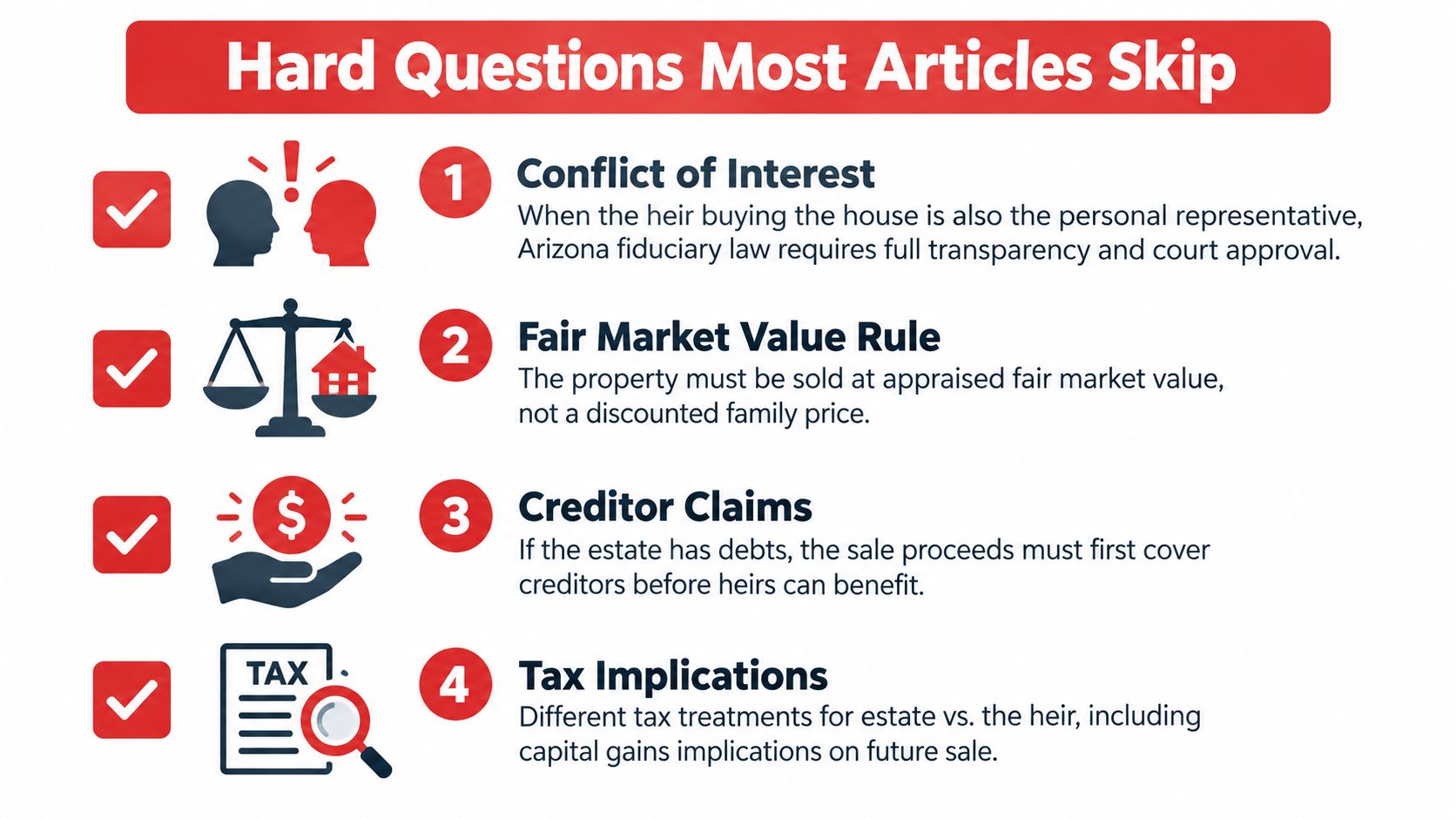
Hard Questions Most Articles Skip
Most articles stop after saying an heir can buy the house. That’s where the easiest part ends.
The risk starts when the buyer and the decision-maker are the same person, or when siblings don’t trust each other’s idea of a fair number.

Conflict of interest is real
If the heir buying the property is also the personal representative, the transaction deserves extra caution. Arizona law gives the representative broad authority, but broad authority doesn’t mean permission to prefer one heir over another.
That means written disclosures, valuation support, and a record showing that the estate didn’t gift a better deal to the insider buyer.
Sibling disagreement changes the strategy
Some families don’t disagree about whether to sell. They disagree about the price, whether to list first, or whether one sibling is being favored.
When that happens, the representative shouldn’t pretend the disagreement doesn’t exist. Better options may include:
- Mediation: A neutral setting can help siblings separate grief from numbers.
- A buyout at supported value: This often works when one heir wants certainty and another wants fairness.
- Court direction in a supervised setting: Sometimes extra oversight protects everyone.
- A later co-owner remedy: If probate closes and heirs end up owning together, separate property law issues can take over.
Documentation protects people, not just files
A fair transaction usually needs more than the buyer’s estimate of value. It often needs an appraisal or at least strong comparable sales support. It also needs every affected heir to receive the same information about the proposed terms.
The representative also has to remember the estate’s obligations to creditors. Arizona law requires notice to creditors, and claims generally must be presented within 4 months after first publication or 60 days after actual notice, whichever is later, as reflected in Maricopa County probate materials on creditor timing. That’s one reason sloppy early distributions can create later trouble.
Practical Steps to Buy the House From the Estate
Families usually do better when they turn a stressful goal into a checklist. Buying the house from an estate is still emotional, but the work itself becomes manageable when each step has a clear purpose.
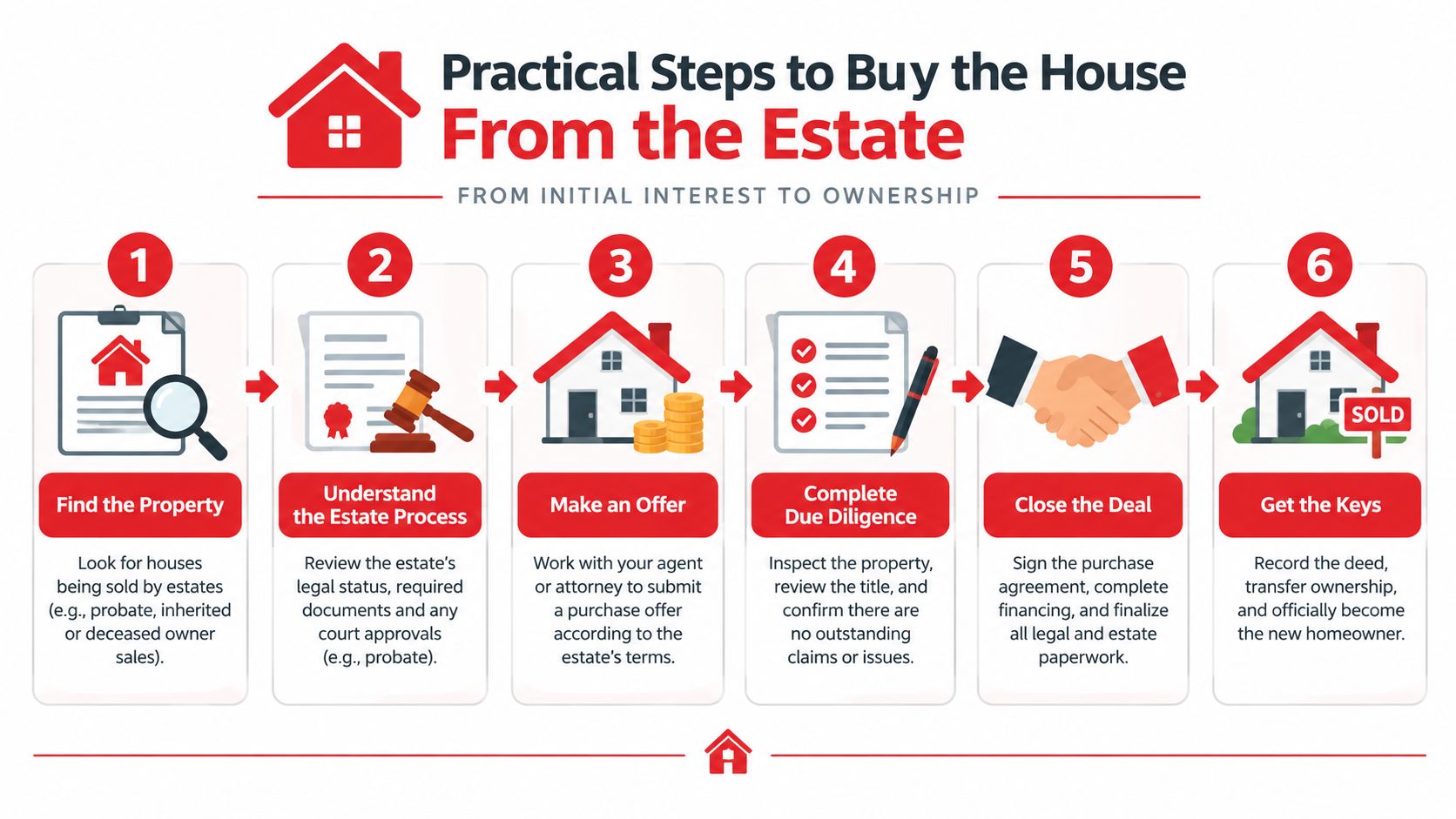
A practical sequence that works in many Arizona cases
- Confirm authority first. Get certified Letters of Personal Representative from the probate court handling the estate.
- Order a defensible valuation. An appraisal is the cleanest option when siblings may question price.
- Put family disclosures in writing. Every affected beneficiary should receive the proposed terms.
- Open escrow with a title company. This helps catch vesting, lien, and title problems before closing day.
- Sign in the correct capacity. The representative signs for the estate. The buyer signs individually.
- Record the deed properly. Title should flow cleanly from the estate to the buyer-heir.
A few practical wrinkles
Out-of-state heirs can usually sign remotely, but the estate should allow extra time for notary coordination, shipping, and identity verification. If a family has trouble locating an interested person, estate teams sometimes review resources like SkipForge skip tracing picks to understand how contact searches are handled in property matters.
If the family wants the highest possible market exposure, listing with an agent may make sense. If the house needs work and the family cares more about simplicity than retail pricing, a direct sale may fit better. One option some Arizona families consider is a direct estate purchase from Red Rock Properties when the property has deferred maintenance, title friction, or the heirs want a simpler close.
For document planning, Red Rock Properties also has a guide to the documents needed to sell an inherited house in Arizona.
Frequently Asked Questions for Arizona Heirs
Can an heir buy the house before probate is completely finished?
Often, yes. Arizona’s system allows administration to continue while the personal representative handles estate property, rather than freezing the house until the very end. The key issue is authority and proper administration, not just waiting for final closure.
What if there is no will?
Arizona intestacy law controls who inherits. For example, the surviving spouse receives the entire intestate estate only in certain situations. If the decedent left one or more children who are not also the surviving spouse’s children, the spouse receives one-half of the decedent’s separate property and no interest in the decedent’s half of community property under A.R.S. 14-2102. That affects who must be treated as an interested heir in a buyout.
Is there a shortcut for small estates?
Sometimes. Arizona recognizes a simplified real-estate affidavit path in certain smaller estates. One Arizona summary states that if the equity value of real property is $100,000 or less and at least 6 months have passed since death, a real-estate affidavit procedure may be used instead of full probate in qualifying cases, as discussed in Arizona small-estate affidavit guidance.
Can an out-of-state heir still buy the property?
Usually, yes. Distance doesn’t block the purchase, but it can slow signatures, identity checks, financing logistics, and communication with the estate.
Is a family buyout always better than selling directly?
Not always. A family buyout can preserve the home and keep control inside the family. A direct sale can reduce conflict, repairs, and delay. The better option depends on whether the family values speed, simplicity, top-dollar exposure, or keeping the property.
Red Rock Properties helps Arizona families evaluate inherited-house options when probate, title issues, deferred maintenance, or sibling disagreements make a normal sale harder than it looks. If a direct sale might fit the estate’s goals, readers can learn more about the company’s approach and request information through Red Rock Properties.