![we buy houses for cash [market_state]](https://image-cdn.carrot.com/eyJidWNrZXQiOiJwcm9kdWN0aW9uLmNhcnJvdC11cGxvYWRzLm9uY2Fycm90LmNvbSIsImtleSI6InVwbG9hZHMvc2l0ZXMvNzcxMjUvMjAyMy8xMi9XZS1CdXktSG91c2VzLUNhc2gtSG9tZS1CdXllcnMtQXJpem9uYS5qcGVnIiwiZWRpdHMiOnsicmVzaXplIjp7IndpZHRoIjoxMTUyfSwidG9Gb3JtYXQiOiJ3ZWJwIiwid2VicCI6eyJxdWFsaXR5Ijo3MH19fQ==)

Yes. In Arizona, a personal representative can sell a house to a family member when the will or court order allows it and the sale is in the estate’s best interest. The risk is that a family sale triggers conflict-of-interest scrutiny, and a mishandled deal can become voidable if it looks like self-dealing or a sweetheart arrangement.
Most families start with the wrong question. They ask whether a relative is allowed to buy the house. The better question is whether the personal representative can prove the sale was fair to everyone else.
That shift matters. A probate house sale to a child, sibling, niece, or other relative isn’t mainly a real-estate issue. It’s a fiduciary-duty issue. Arizona gives personal representatives broad power to sell estate real property, but that power comes with duties to the estate and the people who inherit from it. The representative can’t act like a parent helping one child get a break. The representative has to act like a neutral decision-maker protecting all interested persons.
For grieving families, that distinction can feel cold. It’s also what prevents later lawsuits, family blowups, and closings that unravel after everyone thought the hard part was over.
Table of Contents
- Yes or No, Arizona Lets Executors Sell to Family, With Strings Attached
- What a Personal Representative Is Allowed to Do in Arizona
- Supervised vs Unsupervised Probate and Why It Matters
- The Conflict-of-Interest Rule Buyers Often Miss
- Walking Through a Real Arizona Family-Member Sale
- When the Small-Estate Affidavit Bypasses the Question Entirely
- Frequently Asked Questions for Executors and Family Buyers
Yes or No, Arizona Lets Executors Sell to Family, With Strings Attached
Can an executor in Arizona sell the house to a son, daughter, sibling, or other relative? Yes. The sale is allowed. The problem is not whether Arizona permits a family buyer. The problem is whether the personal representative can prove the deal met fiduciary duties owed to the estate and everyone who stands to inherit.
That distinction decides whether the sale closes cleanly or turns into a probate fight.
Arizona gives personal representatives broad power to sell estate property. But a family-member sale pulls the transaction out of the ordinary real-estate lane and into the conflict-of-interest lane. Once that happens, price, terms, disclosures, and approval all matter more than family agreement around a kitchen table.
Why permission is not the deciding factor
A relative can be a perfectly acceptable buyer. A relative can also be the setup for a voidable transaction if the representative cuts corners, favors one beneficiary, or accepts terms that do not hold up under scrutiny. Arizona’s conflict rules are what make these deals risky, especially when the buyer is closely connected to the fiduciary or when other heirs are getting cashed out.
That is why I tell families to stop asking, “Can my brother buy the house?” Ask this instead: “If an unhappy beneficiary objects later, can we show the sale was fair, documented, and properly approved?”
If the answer is shaky, slow down.
What usually decides whether the sale holds up
Three things matter:
- Authority. The representative needs clear authority under the appointment, the will, or a court order.
- Fair price and terms. The estate should be able to defend the deal as financially fair, not merely convenient for the family.
- Correct probate procedure. Some estates can proceed with little court involvement. Others should get the judge’s signoff before anyone heads to escrow.
That last point gets missed all the time. If you are unsure whether the estate needs judicial approval before signing with a relative, this guide explains when court approval is required for an Arizona probate house sale.
Here is the blunt version. A family sale is not dangerous because the buyer is family. It becomes dangerous when the personal representative treats it like a private family favor instead of a fiduciary transaction.
And in some Arizona estates, this entire question never comes up. If the home passes outside probate or qualifies for a small-estate route, there may be no personal representative sale at all. That is why the first job is to identify the probate path before arguing about who gets to buy the house.
What a Personal Representative Is Allowed to Do in Arizona
A personal representative can sell estate property in Arizona, but the job is bigger than signing listing papers or escrow instructions. The job is fiduciary work. Protect the estate, treat beneficiaries fairly, and build a paper trail that holds up if someone complains later.
The starting point is authority. Title companies and escrow officers usually want to see Letters of Personal Representative before they will treat the estate as the seller. From there, the representative needs to read the will, the appointment documents, and any court restrictions before offering the house to anyone, especially a relative.
Arizona probate also expects the representative to get organized early. The estate should have an inventory and a supportable value for the house. That number is not just clerical paperwork. It becomes the first benchmark for judging whether a later family-member sale was fair or self-serving.
Where the power to sell comes from
A representative’s sale authority usually comes from three places, and you should check all three before you talk price with family.
- The will. A will may give broad sale power, limit it, or direct a specific result.
- Arizona probate law. State law gives a personal representative broad default powers in many estates.
- A court order. A judge can require approval first, or the representative may need to ask for it because of conflict, restrictions, or a dispute.
Here is the practical breakdown:
| Source | What It Allows | What You Need to Watch |
|---|---|---|
| Will | May permit or restrict a sale of the house | Read the exact language before negotiating with family |
| Arizona statute | Often allows the representative to sell estate property | Broad power does not erase fiduciary duties |
| Court order | Approves or limits a specific transaction | Follow the order exactly |
For a plain-English explanation of basic sale power, see whether a personal representative can sell property in Arizona.
What the fiduciary duty requires in real life
This is the part families miss. A personal representative does not get to favor the easiest buyer, the loudest sibling, or the nephew who wants a deal. The representative has to act for the estate.
That means every sale decision should answer a hard question: would this look fair to the beneficiary who already suspects the transaction was tilted?
A good file usually shows:
- why this sale method was chosen
- how the sale price was supported
- whether the property was exposed to the market or otherwise tested
- why the terms help the estate, not just the buyer
- whether beneficiaries were told enough to avoid surprise objections
Documentation matters more in a family sale than in an arm’s-length sale. If the representative cannot explain the price, terms, and process on paper, the problem is not the buyer’s last name. The problem is the representative’s conduct.
A simple rule works well here. Treat the transaction like it will be reviewed later by the one person in the family who likes it least.
Supervised vs Unsupervised Probate and Why It Matters
The same family sale can be routine in one Arizona estate and court-heavy in another. The reason is simple. Arizona probate can be unsupervised or supervised, and the sale process changes with that choice.
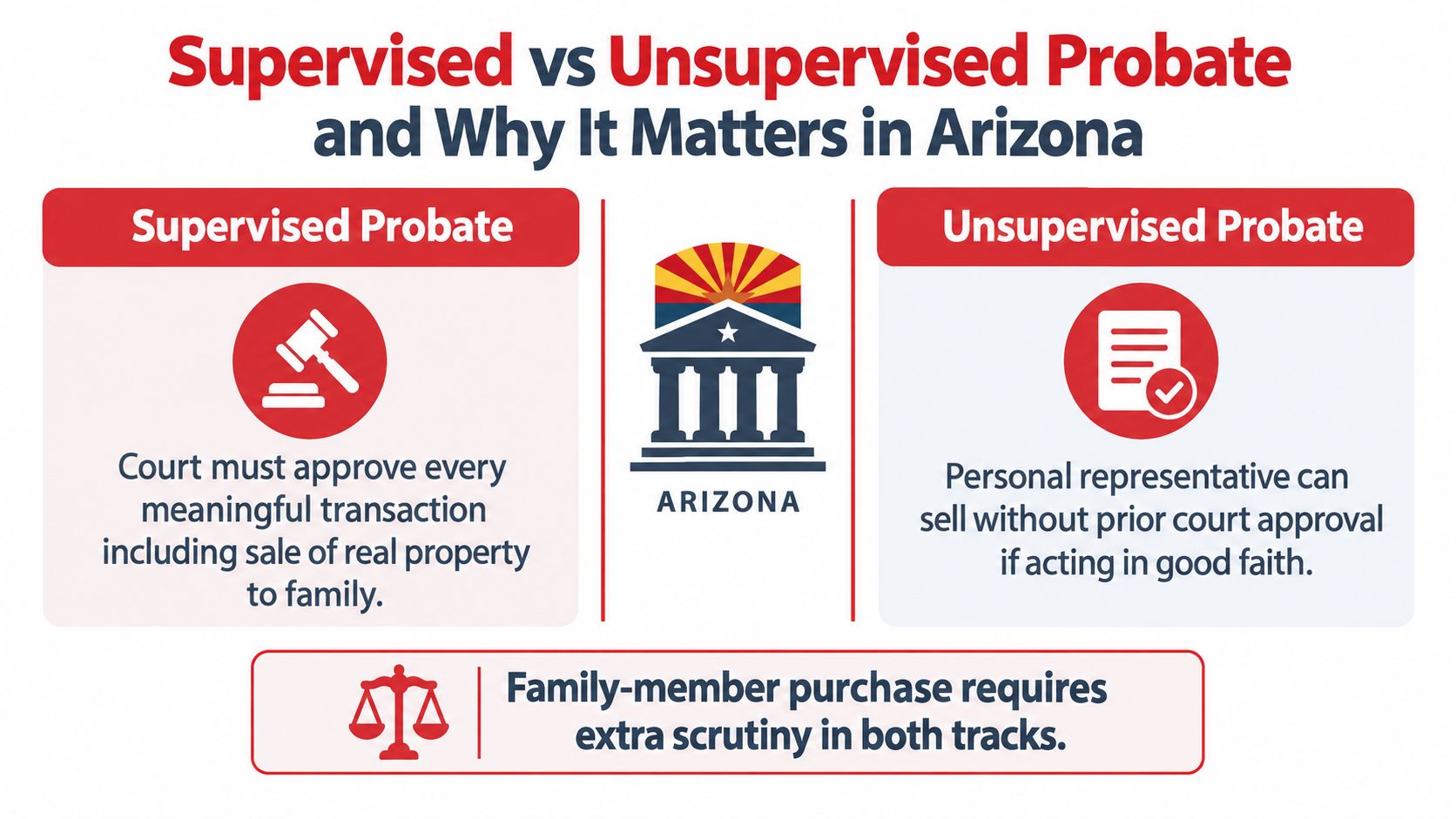
In ordinary unsupervised probate, a personal representative often has room to act without asking the judge for permission every time estate real property is sold. In supervised administration, that freedom disappears.
What changes in supervised probate
Arizona probate guidance is straightforward on this point. In Arizona probate practice, unsupervised administration generally doesn’t require judge approval for each sale, but supervised administration requires court confirmation for every real-property sale under A.R.S. § 14-3504.
That distinction matters a lot in a family transaction.
- In supervised probate: the sale typically can’t close until the court confirms it.
- In unsupervised probate: the representative may sign a contract and close through escrow without a separate sale hearing, assuming the sale fits the representative’s authority and duties.
Readers comparing the two probate tracks can also review this guide to informal and formal probate in Arizona.
Why families get confused
Many people still assume every probate sale needs a judge’s blessing. That’s not true in Arizona. At the same time, many families swing too far the other way and assume that no court involvement means no risk. That’s also wrong.
A family-member sale in unsupervised probate may close. It can still be challenged later if the representative acted poorly.
Court silence doesn’t equal court approval. It may only mean nobody has challenged the deal yet.
The practical lesson is simple. Before negotiating with a relative buyer, the representative should confirm which probate track is in place. That single fact often determines whether the sale moves through escrow on a normal timeline or waits for confirmation from the court.
The Conflict-of-Interest Rule Buyers Often Miss
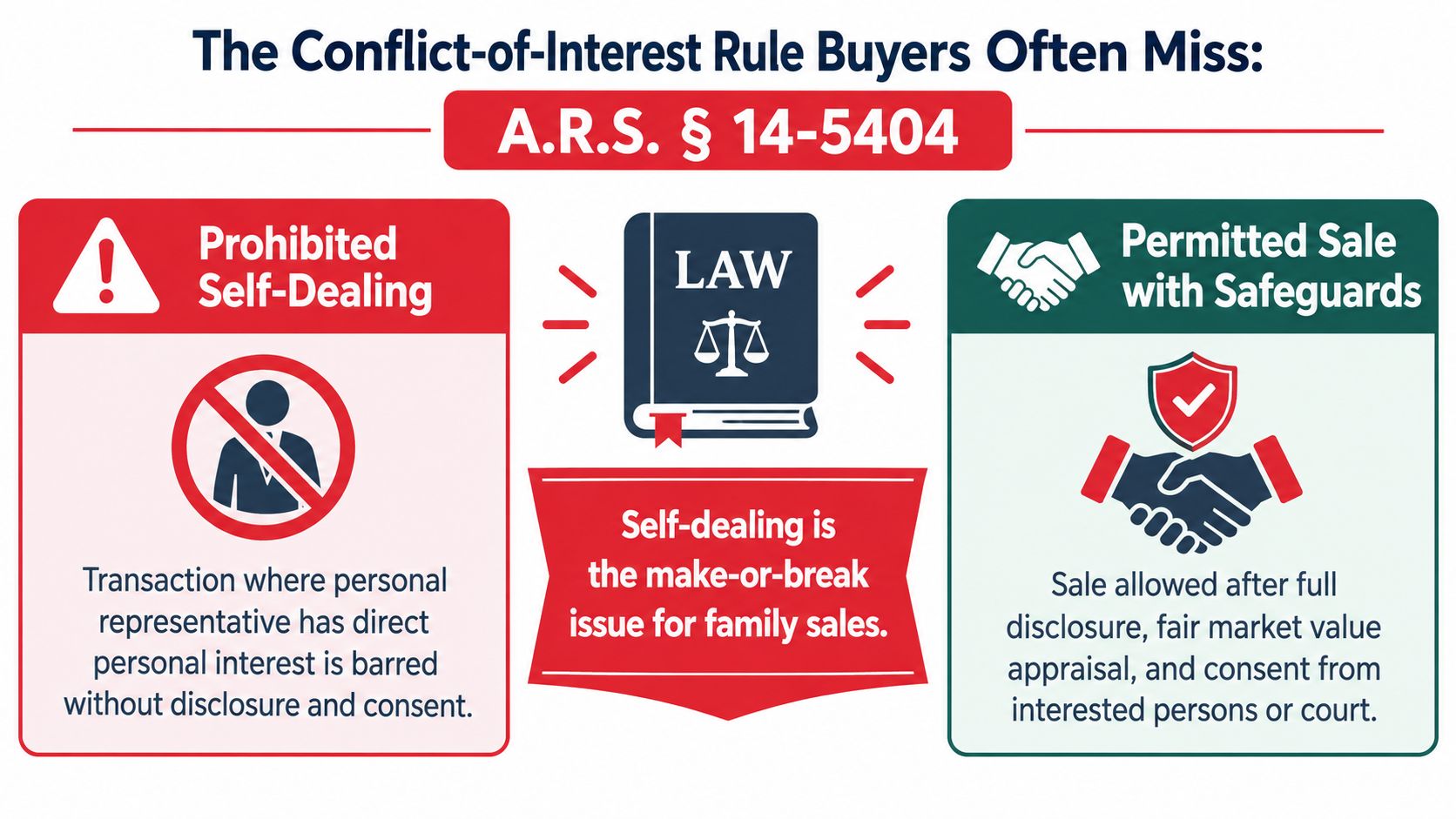
Here is the rule that trips families up. Selling to a relative is not mainly a pricing question. It is a fiduciary-duty question.
Arizona treats a sale connected to the personal representative, or to someone close enough to raise loyalty concerns, differently from a routine open-market deal. The issue is not whether the house is nice, whether the buyer is family, or whether everyone had good intentions. The issue is whether the representative can prove the estate came first.
Why a fair price alone does not fix the problem
An appraisal helps. Clean escrow instructions help. A standard purchase contract helps.
None of that cures a conflicted process by itself.
If the representative sells to a son, daughter, sibling, spouse, or another insider, the file should show exactly why that deal served the estate and not just one branch of the family. That means full disclosure to interested parties, a supportable value, and records showing how the decision was made. If the probate is supervised, court confirmation may also be part of the protection. If the probate is unsupervised, the sale can still be attacked later if the representative cut corners.
That is the point many buyers miss. No judge at closing does not mean no problem later.
What objections usually look like in real life
Beneficiaries usually challenge the facts, not the label. They say:
- The representative gave a relative first pick without a real process
- The sale price was below market
- The house was never exposed to competing buyers
- The other heirs were told too little, too late
- The representative acted fast to help one family member
Those facts give an unhappy heir room to argue that the representative breached fiduciary duties, should be removed, or should pay money back to the estate.
For a plain-English explanation of those duties, read this guide on personal representative responsibilities in Arizona.
A careful representative should assume the sale file will someday be read by the angriest heir in the family, then by a judge. Build the file that way. That means written disclosures, a clear value basis, neutral escrow, and a paper trail that explains why this relative buyer got the house on these terms. That is how you protect the estate, and yourself.
Walking Through a Real Arizona Family-Member Sale
What does a careful Arizona family-member sale look like when the personal representative does it right?
Start with authority, then move to value, then document the conflict. That order matters. A personal representative should confirm the appointment papers, read the will for any sale limits or special instructions, and decide whether the probate is supervised or unsupervised before talking price with a relative. If the buyer is a family member, treat the deal as a fiduciary-duty file from day one, not a casual house sale.
Notice matters too. Arizona probate guidance says the personal representative handbook requires heirs and devisees to receive notice early in the case and a copy of the will in a testate estate. That is one reason rushed side deals create problems. Families can disagree with a sale, but they should not be blindsided by it.
How a clean file usually comes together
A sale to a son, daughter, sibling, niece, or other relative should leave a paper trail that answers the hard question a judge would ask later: why this buyer, at this price, on these terms?
A defensible file usually includes:
- Proof of authority: letters of appointment and any will provisions tied to sale power
- A real value basis: an appraisal, broker price opinion, or other market support kept in the file
- Conflict disclosure in writing: who the buyer is, how they are related, and when the heirs were told
- A normal purchase contract: no handshake deal, no informal transfer
- Neutral escrow and title work: standard closing, standard payoffs, standard settlement statements
- Sale records: offer, counters, notices, disclosures, closing statements, and receipts for estate expenses
If the probate is supervised, the representative should also confirm whether court approval or confirmation is required before closing. If it is unsupervised, the representative still needs the same discipline. The lack of a hearing does not excuse a weak file.
A simple Arizona example
A daughter wants to buy her late mother’s Phoenix house from the estate. The personal representative is her brother. The will gives the personal representative broad authority, but the probate has other beneficiaries, and one of them already suspects favoritism.
Here is the right way to handle it. The brother gets a current value opinion, shares the proposed terms with the interested heirs, uses a written contract through escrow, and keeps records showing why the price is fair to the estate. If the case is supervised, he checks with probate counsel before signing off on a closing date. If he sells it to his sister at a discount because “she is family,” he is no longer acting like a fiduciary. He is picking sides, and that is where removal fights and surcharge claims start.
Sample net-proceeds worksheet
Before accepting a family offer, the personal representative should run the numbers the same way they would for any outside buyer.
| Line Item | Amount | Notes |
|---|---|---|
| Contract price | To be determined | Should match the signed purchase contract |
| Mortgage payoff | To be determined | Confirm through escrow before closing |
| Property taxes | To be determined | Prorated at closing |
| Title and escrow charges | To be determined | Obtain estimated settlement statement |
| Recording and transfer charges | To be determined | Escrow can estimate these |
| Other approved estate costs | To be determined | Only if properly documented |
| Net to estate | To be determined | Amount available for estate use or distribution |
That worksheet does two jobs. It shows whether the estate is being treated fairly, and it helps explain the decision if an heir later questions the sale.
A direct sale may still make sense if the house needs major repairs or the estate needs an as-is option. In that situation, Red Rock Properties is one Arizona buyer that works directly with inherited-property sellers while coordinating with title and escrow. The representative should still compare that route against listing the property or doing repairs first.
Family harmony is not the standard. Fiduciary duty is.
When the Small-Estate Affidavit Bypasses the Question Entirely
Some Arizona families spend weeks debating whether the executor can sell to a relative when they’re asking the wrong probate question. In some lower-value situations, there may be no personal representative sale at all.
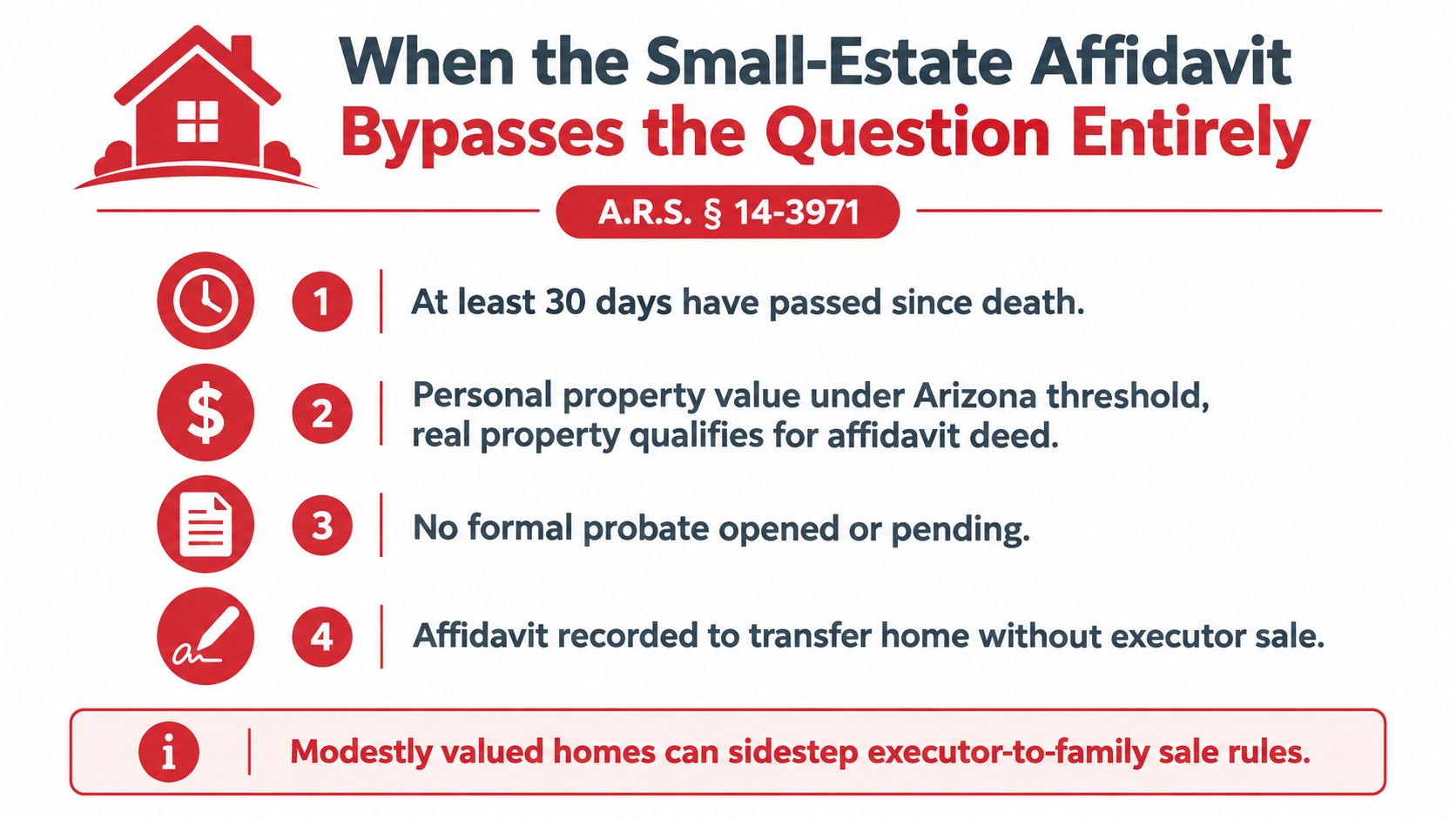
Maricopa County guidance says a small-estate affidavit may be available for real property when the assessed value minus liens is not more than $300,000 and at least six months have passed since death (Maricopa County small-estate real property guidance). That route is designed for successors claiming property, not for a standard sale by a fiduciary.
Why this changes the whole analysis
If the property qualifies for that affidavit process, the family may transfer title through the affidavit route instead of opening a standard probate with a personal representative handling the sale. That means the classic question, “Can the executor sell the house to a family member?” may not be the central issue anymore.
The better question becomes this: after title transfers to the successors, how will the heirs handle a buyout if one wants to keep the house and the others want cash?
That is a different problem. It’s more about co-owner coordination, title transfer, and buyout terms than fiduciary sale authority.
For a plain-English overview, this Arizona small-estate affidavit property guide helps families understand when the affidavit path may fit.
When families should slow down
The affidavit route can be cleaner, but only when the facts fit. Families should verify:
- Current title condition: liens, ownership issues, and recorded interests
- Value threshold fit: assessed value minus liens must meet the county guidance
- Timing: the waiting period has passed
- Heir agreement: everyone understands whether the plan is a transfer, later sale, or one-heir buyout
Some families don’t need a probate sale. They need a clean title transfer first, then a private buyout among heirs on terms everyone can document.
That’s often a much better framing.
Frequently Asked Questions for Executors and Family Buyers
What do families usually get wrong here? They treat this like a house sale, when the primary risk is the personal representative’s duty to the estate.
Does the representative have to notify heirs before closing?
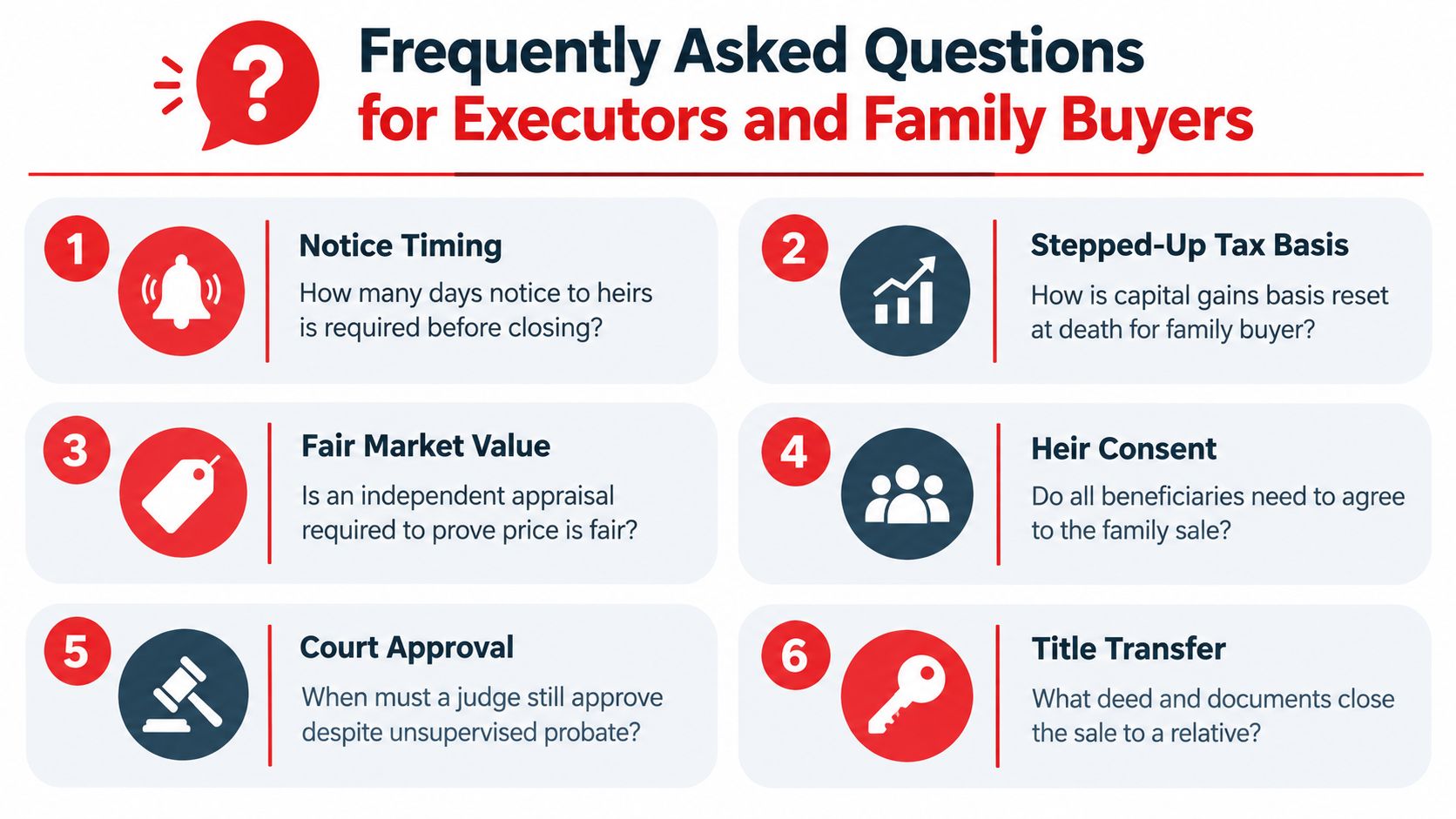
Yes. Once the estate is opened and a personal representative is appointed, heirs and devisees should hear about it early. That notice duty matters because family disputes usually start with surprise. If a sibling first learns about the sale after escrow is underway, the file is already harder to defend.
Action step: Build a full mailing and contact list for heirs and devisees before making decisions about the house.
Does every family-member sale need court approval?
No. Court approval turns on the kind of probate and the authority already in place. In an unsupervised probate, a personal representative often has room to act without coming back for a separate sale order. In a supervised probate, court confirmation is usually the issue that controls the closing timeline.
The smart move is simple. Read the letters of appointment and the court file before you talk price with a relative.
Action step: Confirm whether the probate is supervised before signing a contract with any family buyer.
Can beneficiaries block the sale later?
Yes, if they have a real argument that the personal representative acted outside their authority or favored one family member over the estate. That is why a low-price deal between relatives causes trouble fast. The problem is not that the buyer is family. The problem is that the representative must prove the estate got fair treatment.
A clean file wins arguments.
Action step: Keep written valuations, disclosures to heirs, contract terms, and escrow records in one place.
Should the representative get an appraisal?
Yes, in almost every family sale.
You need a defensible value before you agree to a family discount, seller carryback, repair credit, or private buyout number. The inventory process already forces the representative to put a value on estate assets. A current appraisal, or at least strong written valuation support, shows you took the fiduciary job seriously and did not pull a number out of the air.
Action step: Get a current valuation before negotiating final terms with a relative.
What about taxes and stepped-up basis?
This question comes up late, and that is a mistake. Tax basis, date-of-death value, and the structure of the transfer can change whether a proposed family price makes any sense at all. A bad tax assumption can cost more than the commission families were trying to save.
Action step: Have a CPA or tax attorney review the sale structure before anyone signs.
When is a probate attorney worth hiring?
Hire one early if the buyer is related to the personal representative, the representative is also a beneficiary, the will is unclear, the probate is supervised, or one heir already objects. Those are conflict cases, not paperwork cases.
If the property may qualify for a small-estate affidavit, verify that first. The family may be dealing with a title transfer and heir buyout problem instead of a probate sale problem.
Action step: Get legal review before opening escrow if the sale could be attacked as self-dealing or unfair.
Red Rock Properties works with Arizona families dealing with inherited houses, probate timelines, title issues, and homes that may not make sense for a traditional listing. When a direct sale is the right fit, the company can review the property, explain how an as-is sale would work alongside the probate process, and coordinate with title and escrow. Readers who want to compare that option with listing or a family buyout can visit Red Rock Properties.