![we buy houses for cash [market_state]](https://image-cdn.carrot.com/eyJidWNrZXQiOiJwcm9kdWN0aW9uLmNhcnJvdC11cGxvYWRzLm9uY2Fycm90LmNvbSIsImtleSI6InVwbG9hZHMvc2l0ZXMvNzcxMjUvMjAyMy8xMi9XZS1CdXktSG91c2VzLUNhc2gtSG9tZS1CdXllcnMtQXJpem9uYS5qcGVnIiwiZWRpdHMiOnsicmVzaXplIjp7IndpZHRoIjoxMTUyfSwidG9Gb3JtYXQiOiJ3ZWJwIiwid2VicCI6eyJxdWFsaXR5Ijo3MH19fQ==)

Yes. In Arizona, an estate can sell a house below market value, especially in an unsupervised probate, but the personal representative still needs to justify that discount with real market evidence and the legally relevant date-of-death value. If the estate is in supervised administration, the sale of real property requires court confirmation before it can close.
That answer matters to people who are often dealing with more than a legal question. A daughter may inherit a Phoenix house with an aging roof, an overgrown yard, and a mortgage still due each month. A son living out of state may be trying to clear out a Tucson property while siblings disagree about whether to fix it, list it, rent it, or sell it fast. In those situations, a lower offer can feel unfair at first, even when it may be reasonable.
The confusion usually comes from mixing up two different values. One is the estate’s legal value for probate. The other is the actual sale price a buyer is willing to pay later. Those aren’t always the same, and Arizona probate law treats them differently.
A house can sell for less than its earlier probate value for ordinary reasons. It may need repairs. The local market may have softened. The estate may want certainty and a quicker closing rather than months of cleanup, showings, and carrying costs. What matters is whether the personal representative can show that the decision was made for the estate’s benefit, not for someone’s personal advantage.
Table of Contents
- Understanding What Below Market Value Means for an Arizona Estate
- How Arizona Law Values Estate Property and Sets the Baseline
- When an Arizona Estate Can Legally Sell Below Market Value
- Legitimate Discounts Versus Risky Discounts and How to Tell the Difference
- Protecting the Estate and Heirs When Accepting a Lower Offer
- Your Options Next Steps and Frequently Asked Questions
- Main ways an estate can sell
- Practical next steps
- Frequently asked questions
- Does selling below market value automatically violate a personal representative’s duty
- Can heirs stop a discounted sale
- What if the heirs live outside Arizona
- Does the final sale price control the probate value
- Is a lower offer always the wrong financial choice
- Should a family member be allowed to buy the house at a discount
Understanding What Below Market Value Means for an Arizona Estate
Many heirs hear “below market value” and assume someone did something wrong. Sometimes that’s true. Often, it isn’t.
Suppose three siblings inherit a home in Arizona. The house was lived in for decades. It has deferred maintenance, old flooring, and a leaking air conditioner. One sibling wants to renovate it before selling. Another wants the estate closed quickly. The third lives in another state and doesn’t want to manage contractors. If a buyer offers less than what the family hoped for, that doesn’t automatically mean the price is improper.

Market value and sale price are not always identical
In plain English, market value is the property’s reasonable value in the market under the right valuation standard. But an estate sale price is what a real buyer pays on the chosen timeline, in the home’s real condition, with the estate’s real constraints.
That gap is where people get tripped up.
A property may attract a lower price because:
- Condition problems. Major repairs, outdated systems, or cleanup issues can reduce what buyers will pay.
- Time pressure. The estate may need to pay debts, stop ongoing expenses, or avoid a long sales process.
- Holding costs. Insurance, taxes, utilities, and maintenance keep running while the property sits.
- Buyer expectations. A home sold as-is usually attracts buyers who price in repair risk.
Arizona probate adds another layer. The estate doesn’t start with whatever a buyer later offers. It starts with the property’s value at the decedent’s death. Readers who want a deeper explanation of that concept can review Red Rock’s guide on how fair market value is determined for inherited property in Arizona.
Practical rule: A lower sale price later doesn’t automatically mean the house was “worth less” for probate purposes, and it doesn’t automatically mean the personal representative breached a duty.
Why this issue feels personal
Family homes aren’t just assets on paper. They carry memories, expectations, and sometimes family conflict. One heir may remember holiday dinners there. Another may only see a vacant property with bills attached.
That emotional layer often causes two common mistakes:
- Heirs compare the offer to what they wish the home were worth.
- Personal representatives focus on speed without fully documenting why the lower price makes sense.
Both can lead to disputes. A calm review usually starts by separating hope from evidence. What was the legally relevant value for the estate? What is the property likely to bring in its current condition? What would it cost, in money and delay, to chase a higher number?
Those are the questions that usually matter most.
How Arizona Law Values Estate Property and Sets the Baseline
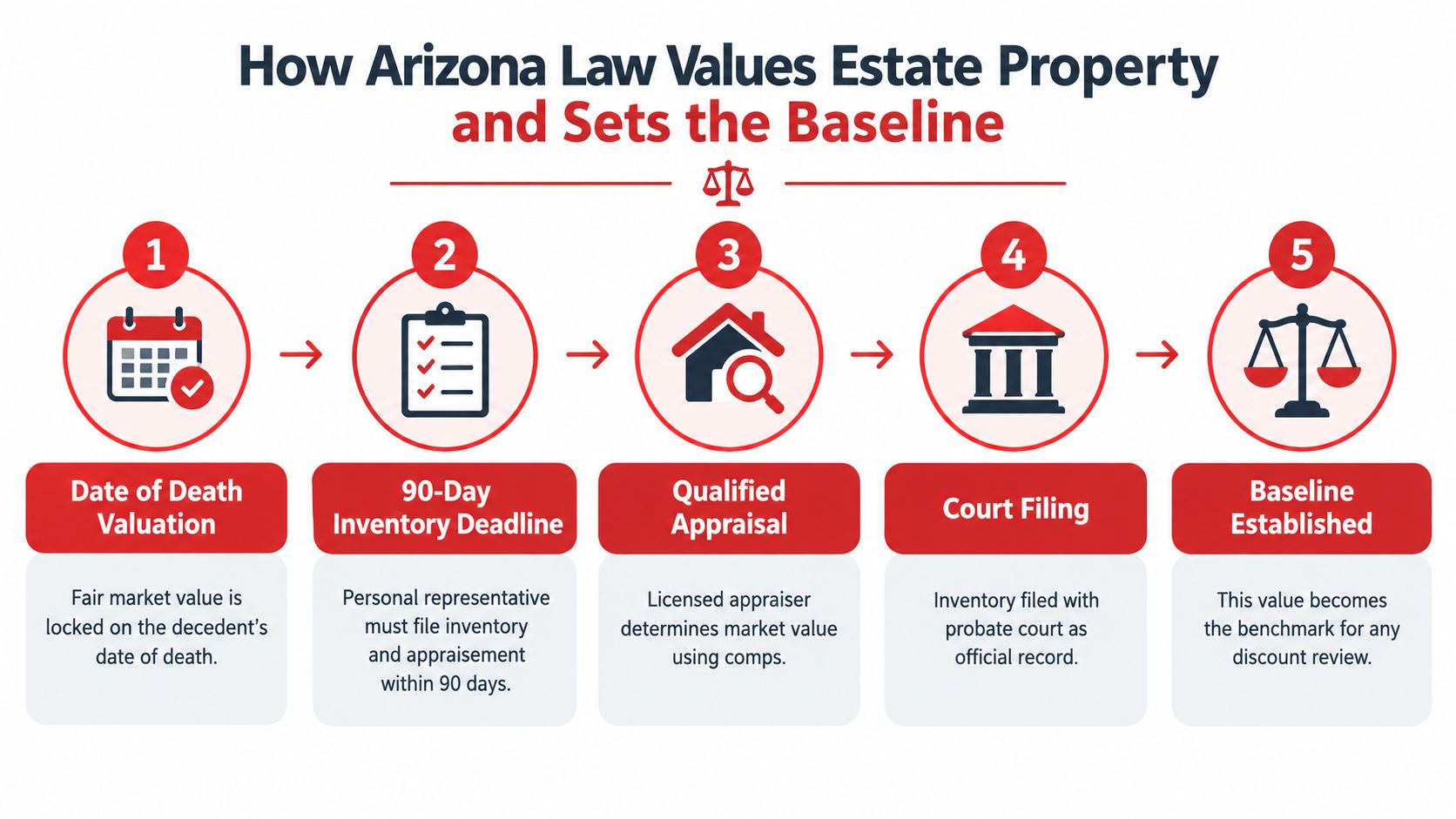
Arizona probate law creates a formal starting point before anyone decides whether a lower offer is acceptable. The personal representative must inventory estate property and state its fair market value as of the decedent’s date of death, along with encumbrances, and that inventory is generally due within 90 days after appointment under Arizona Revised Statutes section 14-3706.
The legal baseline comes first
That date-of-death value is the benchmark. It is not just a rough estimate pulled from a current online home-value tool. It is the estate’s formal valuation point.
A helpful way to think about it is this:
- The owner dies.
- The court appoints a personal representative.
- The representative gathers estate information.
- The house is listed in the inventory at fair market value as of death.
- Only after that baseline is established does a later sale get judged against real-world conditions.
A house may legitimately sell later for less than the recorded inventory value. Arizona probate materials explain that a home can sell below the date-of-death value if the property needs work, the market changes, or the estate wants a faster closing, as discussed in Arizona probate asset valuation guidance.
Liens and debts matter more than many families expect
The probate inventory should also show liens and encumbrances. That changes how heirs should think about value. A home may look valuable at first glance, but the net amount left for heirs can be much smaller once loans, tax issues, or other claims are accounted for.
That point becomes even more important when a family wonders whether full probate is required. Arizona’s small-estate shortcut for real property may be available only when the net value of the decedent’s interest in real property, after liens and encumbrances, is under $300,000 as of death, as explained in Arizona probate thresholds guidance.
For a fuller walkthrough of timing, authority, and sale steps, Red Rock’s article on the Arizona probate real estate sale process can help connect the paperwork to the actual sale timeline.
A current online estimate may be useful for curiosity. It isn’t the legal valuation standard Arizona probate uses.
Common valuation mistakes
Several problems show up again and again when families rush this stage:
- Using today’s estimate instead of date-of-death value. Arizona law ties valuation to death, not the later listing date.
- Ignoring liens. A gross value without debt information can create false expectations.
- Treating the inventory value as a guaranteed sale price. It is a baseline, not a promise.
- Considering offers before confirming authority. A representative should know the scope of appointment before trying to close anything.
When those issues are handled early, later pricing decisions are much easier to defend.
When an Arizona Estate Can Legally Sell Below Market Value
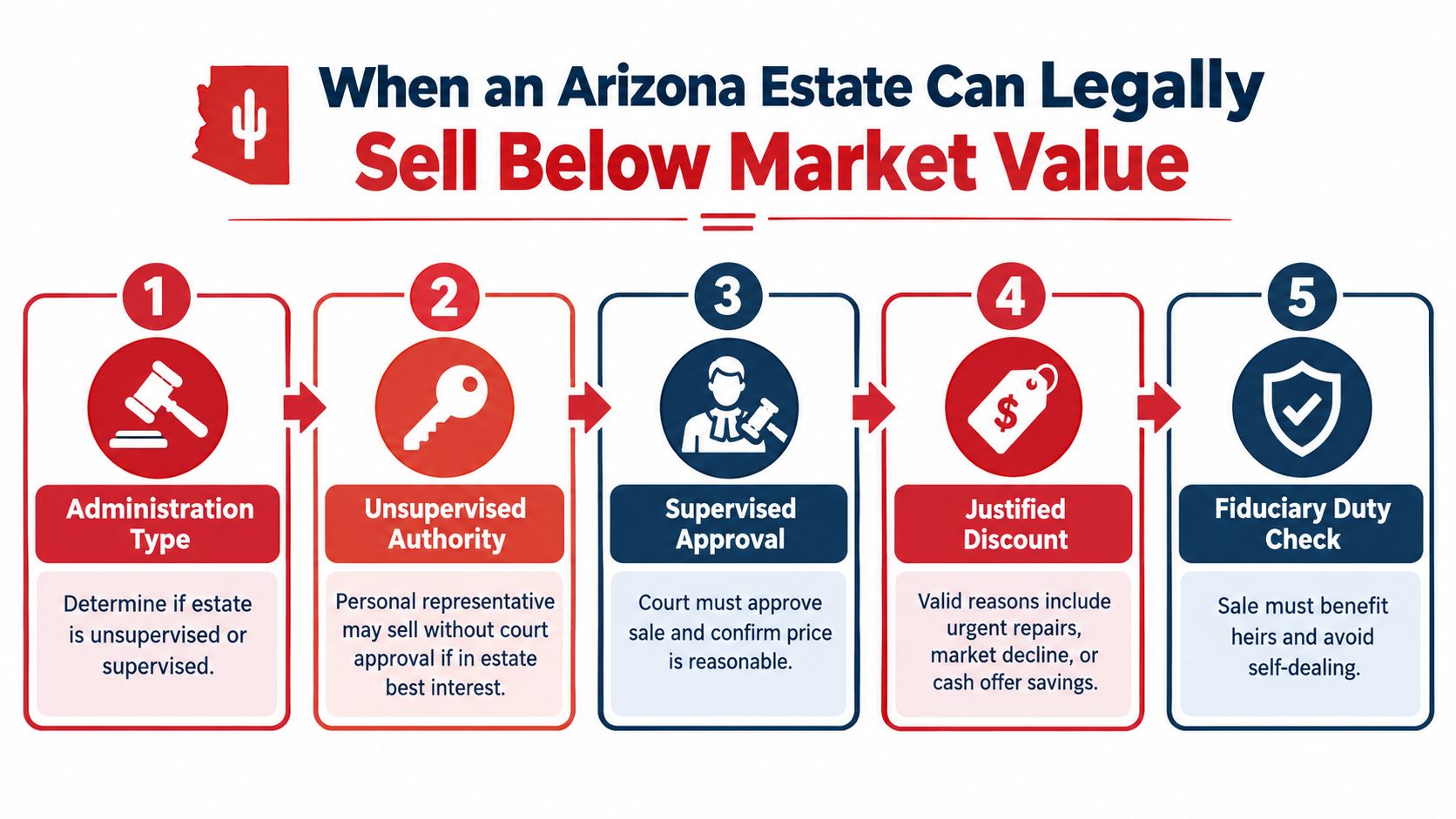
The short answer is still yes, but the legal authority depends on what kind of probate administration is in place and whether the personal representative has clear power to act.
Unsupervised estates usually have more flexibility
In Arizona, an ordinary unsupervised personal representative generally has authority to sell estate real property without asking the court to approve each individual transaction, according to Arizona probate sale authority guidance. That’s why many estate sales move more quickly in unsupervised administration.
But flexibility is not the same as unlimited freedom. The representative still has fiduciary duties. If the sale price looks too low, especially in an off-market or family transaction, the representative may later have to show why that choice benefited the estate.
A practical starting point is making sure the estate has the right paperwork in place. Red Rock’s guide on whether a personal representative can sell property in Arizona helps explain the authority documents heirs should look for before any contract is signed.
Supervised estates must get court confirmation
Arizona handles supervised administration differently. In supervised probate, every sale of estate real property is subject to court confirmation under Arizona’s supervised administration rules.
That means a supervised estate can’t accept a lower offer and close on its own timetable. If an interested person demands confirmation, the personal representative must obtain court approval or risk liability for damages to interested persons under that same source.
There can also be case-specific restrictions. Arizona probate courts may issue appointment orders restricting real-property authority with language such as “NO REALTY SHALL BE LEASED FOR MORE THAN ONE YEAR, SOLD, ENCUMBERED OR CONVEYED WITHOUT PRIOR COURT ORDER,” as shown in Arizona court appointment materials. If that language appears in the order, a discounted sale can’t move ahead because the representative thinks it makes sense.
The first legal question usually isn’t price. It’s authority.
Heir disputes can change the analysis
Some estates don’t have a clean path because heirs disagree about whether to sell, who should buy, or what the property is worth. In those disputes, Arizona partition procedures can lead to a court-determined fair market value using a licensed appraiser, which creates a benchmark and leaves less room for arbitrary pricing, as noted in the earlier Arizona probate sale authority guidance.
That matters in family situations where one heir wants to buy the property at a “family discount.” A lower price might be legal if properly supported, but it becomes much riskier when the buyer is related to the representative or when better market evidence exists and gets ignored.
A lawful below-market sale, then, usually depends on three things:
- Proper authority under the estate’s administration type
- A documented reason for the discount
- A process that protects beneficiaries, especially if the buyer has any relationship to the representative
Without those, the discount may stop looking practical and start looking improper.
Legitimate Discounts Versus Risky Discounts and How to Tell the Difference
Not every discounted estate sale creates a problem. Question is whether the lower price reflects actual market conditions and estate needs, or whether it suggests favoritism, weak documentation, or self-dealing.
Arizona law gives a personal representative power to sell estate property for cash or credit, but families shouldn’t confuse that power with permission to set any price they want. The fiduciary-risk issue becomes sharper when the buyer is a relative, a friend, or anyone connected to the representative. That concern is reflected in Arizona Revised Statutes section 14-3715, which supports the broader duty to act for the estate’s benefit.
Defensible Discount vs Potential Breach of Duty
| Factor | Defensible Market Discount | Potential Red Flag |
|---|---|---|
| Property condition | The home needs major repairs, cleanup, or updating, and the lower price reflects that reality | The representative claims the house is “rough” but has no inspection, photos, bids, or other support |
| Speed of sale | The estate needs a faster closing to reduce carrying costs or handle debts | The representative rushes the sale without exposing the property to any meaningful market check |
| Buyer relationship | The buyer is unrelated, or the transaction is fully documented and clearly arm’s-length | The buyer is a relative or insider, and the discount isn’t backed by solid market evidence |
| Value support | The price lines up with appraisal work, comparable sales, or condition-based pricing logic | The representative skips valuation work and relies on guesswork |
| Estate benefit | The lower offer creates a better overall outcome once repair burden, delay, and risk are considered | The sale mainly benefits one person while reducing what other heirs likely receive |
A useful way to test the decision
One helpful question is whether the representative could calmly explain the deal to every beneficiary in writing.
If the explanation sounds like this, the sale may be defensible: the home needs substantial work, the estate doesn’t want to fund repairs, buyers priced that risk in, and the accepted offer avoids prolonged expenses and uncertainty.
If the explanation sounds like this, the risk goes up: a family member wanted the house, the estate chose not to test the market, and nobody gathered much proof because everyone hoped it would “just work out.”
For families dealing with distressed condition, Red Rock’s guide on selling a house as-is in Arizona can help frame how repair issues affect price without assuming every lower offer is unfair.
A discount is easier to defend when the estate can show not only what it gave up on price, but what it avoided in repairs, delay, and ongoing property risk.
Protecting the Estate and Heirs When Accepting a Lower Offer
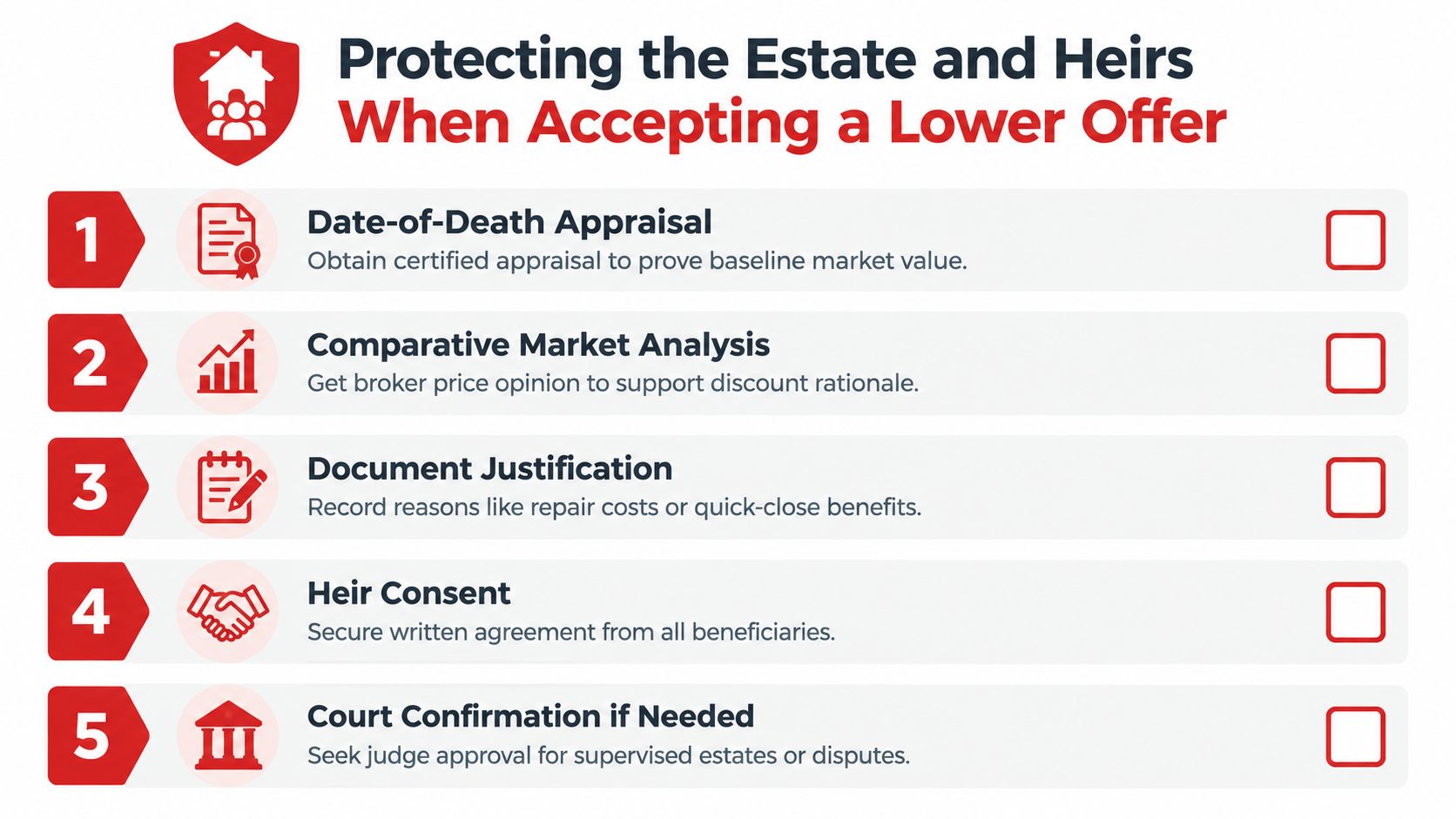
A personal representative doesn’t need perfection. The estate does need a process that makes the decision understandable and defensible.
Steps that reduce problems later
Several practical habits can protect both the estate and the representative:
- Document date-of-death value early. Arizona’s inventory rule makes that the legal baseline, so it should be established before pricing arguments begin.
- Keep market support for the lower offer. Comparable sales, repair estimates, photos, and written notes can help explain why the accepted price made sense.
- Disclose liens and encumbrances clearly. Those affect what the estate is really receiving, not just the gross contract price.
- Communicate with beneficiaries. Disputes often grow when heirs hear about a sale late and assume something was hidden.
- Confirm authority before signing. Missing Letters of Personal Representative or trying to sell before appointment can derail the transaction.
Readers who need a broader view of the representative’s role can review Red Rock’s article on personal representative responsibilities in Arizona.
Tax treatment is related, but not identical
Families also get confused about taxes after a discounted sale. Probate valuation and tax reporting are related, but they aren’t the same issue.
For inherited property, the IRS generally resets the heir’s cost basis to the property’s fair market value on the date of death under step-up-in-basis rules, as explained in inherited property tax basis guidance. That means a later sale below that date-of-death value can reduce or eliminate taxable gain rather than create extra gain.
The practical takeaway is simple. A house can be worth one amount for the probate inventory, then sell later for less because of repairs or speed, and those two facts can both be legitimate. But the paperwork should tell a clear story.
Important: A lower sale price does not automatically prove the earlier probate valuation was wrong, and the later discount doesn’t automatically create a tax problem in the way many heirs fear.
Common mistakes to avoid
The most common avoidable errors are usually procedural:
- Relying on a current online estimate instead of the legal date-of-death standard.
- Accepting a family offer without enough documentation.
- Forgetting that a supervised estate may need court confirmation.
- Failing to share the reasoning with beneficiaries before conflict hardens.
- Treating speed as the only goal when fiduciary duty still applies.
When those mistakes are avoided, a lower offer can be accepted without turning the sale into a larger estate dispute.
Your Options Next Steps and Frequently Asked Questions
A lower offer is only one possible path. Arizona heirs usually have several options, and the right one depends on the home’s condition, the estate’s timeline, the level of family agreement, and the representative’s authority.
Main ways an estate can sell
List the home traditionally.
This can make sense when the house is in solid shape, the family has time, and the estate wants broad market exposure. The tradeoff is more preparation, ongoing showings, and a less certain timeline.
Repair before selling.
That may produce a stronger final price in some situations, but it also means spending estate money, managing contractors, and accepting the risk that the added effort still won’t pay off as hoped. In some northern Arizona markets, presentation matters a great deal, and practical improvements tied to staging and curb appeal in Flagstaff can help families think through what preparation adds value before they commit to a repair plan.
Sell directly in as-is condition.
This option can fit estates dealing with deferred maintenance, distance, cleanup burdens, or a need for a simpler closing. It may bring a lower gross price than a fully prepared retail sale, but it can reduce time, repair work, and uncertainty. One possible path is a direct sale to a local buyer such as Red Rock Properties, which purchases Arizona homes in inherited and distressed situations when that structure fits the estate’s needs.
Practical next steps
A calm next step often looks like this:
- Gather the estate documents. Death certificate, will or trust, court appointment papers, and title information usually come first.
- Confirm the administration type. The answer affects how much freedom the representative has.
- Establish the valuation record. The estate should know its date-of-death baseline before weighing offers.
- Compare the real options. Not just price, but repairs, time, risk, debt payoff, and family impact.
- Talk with qualified professionals when needed. Probate and tax questions can turn quickly on specific facts.
Frequently asked questions
Does selling below market value automatically violate a personal representative’s duty
No. A lower sale price can be proper if the representative can support it with market evidence, property condition, timing concerns, and estate benefit. The risk rises when the deal appears arbitrary or favors a connected buyer.
Can heirs stop a discounted sale
Sometimes. In supervised administration, court involvement already plays a direct role. In other situations, heirs may challenge a sale they believe is unreasonable or harmful to the estate, especially if they think the representative acted without proper support or with a conflict.
What if the heirs live outside Arizona
Out-of-state heirs can still participate, review documents, and raise questions. Distance often increases the appeal of selling as-is, but it also makes written communication and organized records even more important.
Does the final sale price control the probate value
Not necessarily. Arizona probate uses the date-of-death value as the formal benchmark for the estate inventory. The later sale price may be different for legitimate reasons.
Is a lower offer always the wrong financial choice
No. Sometimes a lower offer produces the better overall result when repairs, delay, uncertainty, and monthly holding costs are considered together.
Should a family member be allowed to buy the house at a discount
That situation deserves extra caution. It may be possible in some cases, but it needs especially strong documentation and, in many families, legal guidance to reduce claims of favoritism or self-dealing.
Red Rock Properties helps Arizona families evaluate inherited and probate property sales with a practical, education-first approach. When a direct as-is sale may make sense, the company can review the property, explain how condition and timeline affect price, and coordinate a straightforward closing process. Readers who want to explore that option can visit Red Rock Properties.